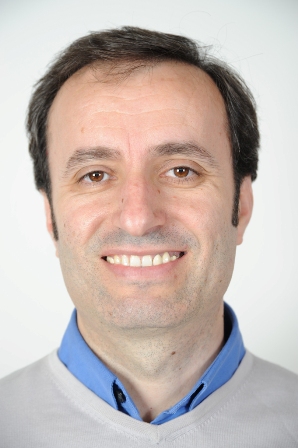
Professor Aurel Ymeti
Aurel Ymeti is cofounder and CEO of Nanoalmyona BV, a high-tech Dutch company specialized in research and technology development, project management and new business development in Hightech Systems and Materials, including integrated photonics, Lab-on-a-Chip biosensing, optoelectronics, microscopy, and nanomedicine.
He earned his MSc in Theoretical Physics from the University of Tirana, Albania in 1996, and his Ph.D. in Applied Physics/Nanotechnology from the University of Twente, Netherlands in 2004, working on the development of ultrasensitive multichannel integrated photonic (bio-)sensing platforms. Subsequently, he worked as a postdoctoral research fellow at the same university on development of portable devices for staging of HIV infection in point-of-care settings, later commercialized by Immunicon/Veridex (J&J).
In 2008 Aurel cofounded Ostendum, a spin-off company of the MESA+ Institute for Nanotechnology of the University of Twente, focusing on the commercialization of extremely sensitive and label-free optical analysis methods for rapid detection of micro-organisms and biomarkers based on the Lab-on-a-Chip Nanotechnology, initially invented and developed by Aurel during his Ph.D. project. As CTO at Ostendum, he was responsible for the research and technology development, product management and new business development.
In 2017, Aurel was appointed as Associate Professor at the Department of Engineering Physics, Polytechnic University of Tirana, Albania, working on application of High Tech Systems and Materials in innovative product development.
Aurel has (co)authored about 40 publications in refereed journals, peer-reviewed conference proceedings, and books, is inventor of several patents, and has presented more than 30 keynote/invited lectures in (inter)national conferences. He was/is involved as a member of the International Society for Optics and Photonics (SPIE), Optical Society of America (OSA), International AIDS Society (IAS), International Society for Analytical Cytology (ISAC), and Advisory Board Member of the Lifeboat Foundation. Aurel has served as Program Committee Member of several international conferences, including the SPIE conference series of Defense, Security, and Sensing (2010–2015).
His work on photonic biosensors has been featured in many well-known international media publications, incl. MIT’s Technology Review, Nature, Le Monde, and BBC Focus Magazine and in 2007 the highly reputable business magazine Forbes has highlighted his work as one of the “13 Amazing New Nanotechnologies”. Aurel has received several awards including the prestigious European Lab-on-a-Chip Nanodevices Technology Innovation Leadership Award from Frost & Sullivan in 2013.
Read his LinkedIn profile.