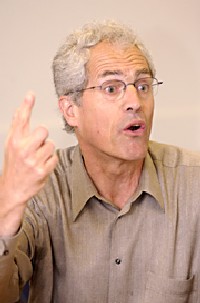
Professor Jean-Pierre Dupuy
The paper Living with Uncertainty: Toward the Ongoing Normative Assessment of Nanotechnology (published in Nanotechnology Challenges: Implications for Philosophy, Ethics and Society) said
“It is often asserted that the starting point of nanotechnology was the classic talk given by Feynman (1959), in which he said: ‘The principles of physics, as far as I can see, do not speak against the possibility of maneuvering things atom by atom … It would be, in principle, possible (I think) for a physicist to synthesize any chemical substance that the chemist writes down. Give the orders and the physicist synthesizes it. How? Put the atoms down where the chemist says, and so you make the substance.’ Today’s champions of nanotech add: ‘We need to apply at the molecular scale the concept that has demonstrated its effectiveness at the macroscopic scale: making parts go where we want by putting them where we want!’ (Merkle 2003)This cannot be the whole story. If the essence of nanotechnology were that it manipulates matter on the atomic scale, no new philosophical attitude different from the one to other scientific disciplines would be necessary. Indeed, chemistry has been manipulating matter on the atomic scale for at least the past two centuries. We believe there is indeed some kind of unity behind the nanotech enterprise and the NBIC convergence (Roco et al. 2002); but that this unity lies at the level of the ‘metaphysical research program’ that underpins such convergence. It is at this level that nanoethics must address novel issues.”
Jean-Pierre Dupuy, Ph.D. was coauthor of this paper and is Professor of Social and Political Philosophy at the École Polytechnique, Paris. He is the Director of research at the C.N.R.S. (Philosophy) and the Director of C.R.E.A. (Centre de Recherche en Épistéologie Appliquée), the philosophical research group of the École Polytechnique, which he founded in 1982. At Stanford University, he is a researcher at the Study of Language and Information (C.S.L.I.) and is by courtesy a Professor of Political Science.
His interests are cultural theory, social and political philosophy, the cognitive sciences, the epistemology of the social sciences, and the relationship of current critical theory to logical and scientific thinking.
In his book The Mechanization of the Mind, Jean-Pierre explains how the founders of cybernetics laid the foundations not only for cognitive science, but also artificial intelligence, and foreshadowed the development of chaos theory, complexity theory, and other scientific and philosophical breakthroughs.
Jean-Pierre authored Some Pitfalls in the Philosophical Foundations of Nanoethics, Choosing to Intend, Deciding to Believe, The Philosophical Foundations of Nanoethics: Arguments for a Method, Common Knowledge, Common Sense, Philosophical Foundations of a new Concept of Equilibrium in the Social Sciences: Projected Equilibrium, Living with Uncertainty: From the Precautionary Principle to the Methodology of Ongoing Normative Assessment, Intersubjectivity and Embodiment, Avions-Nous Oublié le Mal? Penser la Politique Aprés le 11 Septembre, El Panico, and El Sacrificio y La Envidia, coauthored Competencies for the Good Life and the Good Society and La Traicion de La Opulencia, and edited Self-Deception and Paradoxes of Rationality.