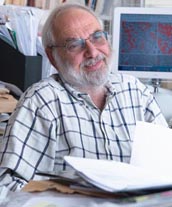
Professor Yechezkel “Chezy” Barenholz
The PhysOrg article Overcoming Drug Resistance — Nanoparticles Trigger Built-In Cell-Death Signal said
“One of the most vexing problems in treating cancer is the propensity of tumors to develop resistance to a wide range of anticancer drugs. Over 70 percent of ovarian cancer patients, for example, have drug-resistant tumors at the time of their initial diagnosis, and virtually all patients who relapse have drug-resistant tumors.Researchers have identified the major mechanisms that cancer cells use to neutralize the cytotoxic, or cell-killing, effects of anticancer drugs, and now they are using nanotechnology to help derail drug resistance and improve the odds of successfully treating cancer.
Yechezkel Barenholz, Ph.D., and his collaborators at the Hebrew University-Hadassah Medical School in Jerusalem added a lipid-polymer construct to liposomes intended to encapsulate ceramide. The resulting nanoparticles were far more stable than standard liposomes. As a result, these liposomes were able to deliver larger doses of ceramide to tumor cells, increasing the therapeutic efficacy of ceramide administration. The resulting liposomes were also more stable when stored, a useful characteristic should such a formulation eventually receive regulatory clearance for use in humans.”
Yechezkel “Chezy” Barenholz, Ph.D. is Professor of Biochemistry and head of the Department of Biochemistry at the Hebrew University of Jerusalem. He is on the Editorial Boards of Chemistry and Physics of Lipids and the Journal of Liposome Research. He is one of the key inventors of DOXIL, marketed by Johnson & Johnson as a cancer treatment.
In basic research, he focuses on biochemistry and biophysics of lipids and membranes — on the relationships between membrane lipid composition, structure (e.g., rafts), and function; on lipid mediated signal transduction; and on apoptosis. One of the main biological topics studied is the relevance of the above to aging processes.
In applied research, Chezy’s main interests are in amphiphile-based drug carriers, especially liposomes: from basic aspects of design of the drug carriers through animal studies and clinical trials, and finally, FDA-approved drugs. This is best exemplified by the development of DOXIL (a doxorubicin remote-loaded sterically-stabilized ~100 nm liposome for treatment of cancer).
Among his 300+ publications, Chezy coedited Handbook of Nonmedical Applications of Liposomes, and coauthored Dynamics of the Hydrocarbon Layer in Liposomes of Lecithin and Sphingomyelin Containing Dicetylphosphate, Pharmacokinetics of Pegylated Liposomal Doxorubicin: Review of Animal and Human Studies, Electrostatic and structural properties of complexes involving plasmid DNA and cationic lipids commonly used for gene delivery, Prolongation of the Circulation Time of Doxorubicin Encapsulated in Liposomes Containing a Polyethylene Glycol-Derivatized Phospholipid: Pharmacokinetic Studies in Rodents and Dogs, and Electrostatic parameters of cationic liposomes commonly used for gene delivery as determined by 4-heptadecyl-7-hydroxycoumarin.
His 30+ patents include Sphingolipids’ Polyalkylamines Conjugates, Liposomal analgesic drug compositions prepared in GMV using an ammonium sulfate gradient, Liposomal Formulations Comprising an Amphipathic Weak Base Like Tempamine for Treatment of Neurodegenerative Conditions, Liposomal Compositions of Glucocorticoid and Glucocorticoid Derivatives, Combination Therapy, Use of Liposomal Glucocorticoids for Treating Inflammatory States, Method for Selecting Cationic or Anionic Liposomes for Treatment of a Mucosa Membrane, and Kit Comprising the Same, Enhanced circulation effector composition and method, and Platinum complexes and their use in therapy.
Chezy earned his undergraduate, M.Sc., and Ph.D. degrees in Biochemistry from the Hebrew University, Jerusalem in 1965, 1968, and 1971, respectively.