Toggle light / dark theme

How does a developing brain self-organize? Cell lineage may guide neuron placement

Your brain begins as a single cell. When all is said and done, it will house an incredibly complex and powerful network of some 170 billion cells. How does it organize itself along the way? Cold Spring Harbor Laboratory neuroscientists have come up with a surprisingly simple answer that could have far-reaching implications for biology and artificial intelligence.

Stan Kerstjens, a postdoc in Professor Anthony Zador’s lab, frames the question in terms of positional information. “The only thing a cell ‘sees’ is itself and its neighbors,” he explains. “But its fate depends on where it sits. A cell in the wrong place becomes the wrong thing, and the brain doesn’t develop right. So, every cell must solve two questions: Where am I? And who do I need to become?”

In a study published in Neuron, Kerstjens, Zador, and colleagues at Harvard University and ETH Zürich put forward a new theory for how the brain organizes itself during development.

These biological computers actually use neurons

In this video we look into one of the developing areas of computing: wetware. Most specifically neuromorphic computing, a science which uses actual neurons on chips.

We talk to Cortical labs, the company that developed the pong-playing dish brain, and professor Thomas Hartung to understand what the benefits of this technology are.

🚀 Discover deep-dive engineering stories and breakthrough technologies on Interesting Engineering:
/ @interestingengineeringie.

🪖 Explore military innovation and defense technology on Military Mechanics:
/ @militarymechanicsie.

🔔 Subscribe to IE Brief for daily updates on the discoveries, technologies, and global developments shaping our world:
/ @ienews-brief.

🔬 Complex tech, simply explained. Discover how the world works with IE Explains: / @ie-explains

Whole Brain Emulation & Substrate-Independence: New Beginnings For Old Minds

When a human mind can be emulated — memories, habits, and the weather of thought running on engineered hardware — “uploading” stops being an ending and becomes a beginning. Substrate-independent minds can be backed up, restored, paused without time passing, and deployed into new bodies: telepresence robots, swarms, or chassis built for heat and radiation. Distance turns into bandwidth as consciousness moves as data, bound only by light. Under the spectacle is a harder, technical question: what must be captured, at what scale, for an emulation to be someone — and what rights and power follow once persons are portable infrastructure?

Mind uploading has usually been told as a one-way escape hatch: a last-minute transfer from a failing body into a machine, the technological equivalent of outrunning a deadline. That framing makes the idea feel like a hospice fantasy — dramatic, personal, terminal. But it leaves out the second verb that changes everything. If a mind can be reproduced as a running process, it isn’t just uploaded once; it can be instantiated again, moved, paused, restored, and redeployed. Uploading is capture. Downloading is what makes a mind into something mobile.

The phrase “substrate-independent mind” tries to name that mobility without the melodrama. A substrate is the medium a mind runs on: biological tissue, silicon, specialized hardware, something not yet invented. Independence doesn’t mean the mind floats free of physics; it means the same meaningful mental functions might be implementable on different platforms, like a program that can run on different computers. The promise is not that neurons are irrelevant, but that the mind might be the pattern of information processing the neurons carry out — the thing they do, not the stuff they’re made of.

Biology, not physics, holds the key to reality

Three centuries after Newton described the universe through fixed laws and deterministic equations, science may be entering an entirely new phase.

According to biochemist and complex systems theorist Stuart Kauffman and computer scientist Andrea Roli, the biosphere is not a predictable, clockwork system. Instead, it is a self-organising, ever-evolving web of life that cannot be fully captured by mathematical models.

Organisms reshape their environments in ways that are fundamentally unpredictable. These processes, Kauffman and Roli argue, take place in what they call a “Domain of No Laws.”

This challenges the very foundation of scientific thought. Reality, they suggest, may not be governed by universal laws at all—and it is biology, not physics, that could hold the answers.

Tap here to read more.

Neurons receive precisely tailored teaching signals as we learn

How does the brain know which neurons to adjust during learning in order to optimize behavior? MIT researchers discovered that brains can use cell-by-cell error signals to do this — surprisingly similar to how AI systems are trained via backpropagation.


When we learn a new skill, the brain has to decide—cell by cell—what to change. New research from MIT suggests it can do that with surprising precision, sending targeted feedback to individual neurons so each one can adjust its activity in the right direction.

The finding echoes a key idea from modern artificial intelligence. Many AI systems learn by comparing their output to a target, computing an “error” signal, and using it to fine-tune connections within the network. A longstanding question has been whether the brain also uses that kind of individualized feedback. In a study published in the February 25 issue of the journal Nature, MIT researchers report evidence that it does.

A research team led by Mark Harnett, a McGovern Institute investigator and associate professor in the Department of Brain and Cognitive Sciences at MIT, discovered these instructive signals in mice by training animals to control the activity of specific neurons using a brain-computer interface (BCI). Their approach, the researchers say, can be used to further study the relationships between artificial neural networks and real brains, in ways that are expected to both improve understanding of biological learning and enable better brain-inspired artificial intelligence.

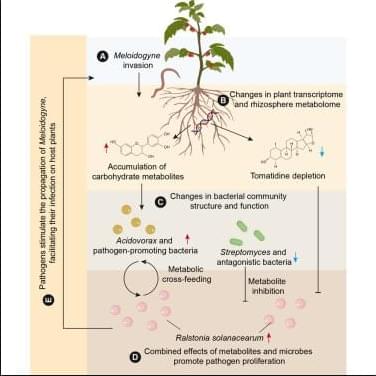
Meloidogyne nematodes reprogram rhizosphere metabolism to suppress antagonistic microbiota and enable bacterial pathogen co-infection

Xu et al. reveal that co-infection of nematodes and pathogens is a global phenomenon. Root-knot nematodes reprogram rhizosphere metabolism, reducing defensive tomatidine while increasing sugars that reshape rhizosphere microbiome. These changes suppress antagonistic microbes and promote pathogen proliferation, which enhances nematode survival and gall formation, leading to complex co-infection dynamics.

Algal Swimming Patterns Change with Light Intensity

In response to changes in illumination, a swimming microorganism reverses the direction of its circular trajectory by tilting its flagella’s planes of motion.

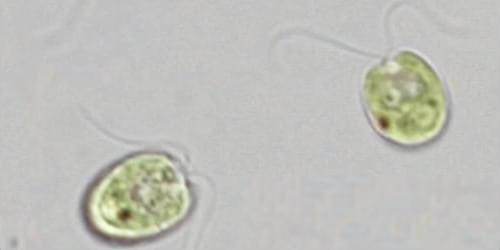
Many microorganisms adjust their swimming trajectories in response to environmental signals such as nutrients or light. Researchers have now discovered a new mode of such behavior in a species of green algae [1]. The microbes swim in wide circles when illuminated and switch from counterclockwise (CCW) to clockwise (CW) swimming when the light intensity is above a threshold value. The researchers determined how this change is generated by the algae’s two whip-like flagella. They say that the results reveal a new navigation strategy that microorganisms can use to find optimal environments.

The single-celled green alga Chlamydomonas reinhardtii is photosynthetic and moves toward light by beating its two flagella, situated close together on its front surface, in a breaststroke pattern. In 2021, Kirsty Wan and Dario Cortese of the University of Exeter in the UK figured out the beating pattern that produces the microbe’s typical corkscrew-shaped trajectory, which follows a tight helix [2]. They showed how changing the frequency, amplitude, and synchronization of the flagellar beating allows the cell to change the overall direction of motion, perhaps to steer it toward or away from a light source and optimize the intensity of light it receives.

/* */