Toggle light / dark theme

Sensitive CAR T cells redefine targetable CD70 expression in solid tumors

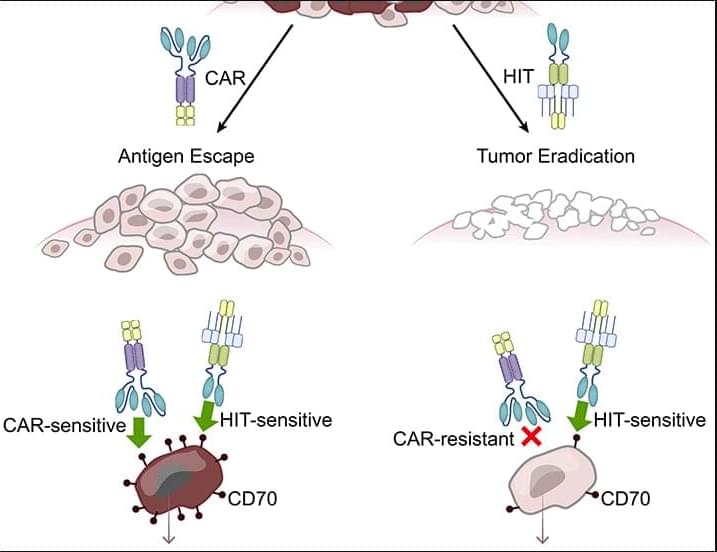
Solid tumor antigen heterogeneity is a major challenge for cancer immunotherapies, including chimeric antigen receptor (CAR) T cells. Unlike CD19 for B cell malignancies, no target with pan-cellular expression in solid tumors and absence in normal vital cells has been identified. CD70 is a promising candidate, physiologically confined to immune cell subsets and aberrantly expressed in many cancers. We show that heterogeneous CD70 expression in tumors is epigenetically regulated, ranging from high to very low in individual cells, appearing negative by conventional detection methods. Using a highly sensitive CD70 receptor, HLA-independent T cell (HIT) receptor coexpressing CD80 and 4-1BBL for costimulation, we efficiently eliminated CD70-heterogeneous tumors that evade prototypic CAR T cells. These findings provide a potential strategy to treat a broad range of solid tumors.

Thermogenetics: How proteins are controllable by heat

Protein activity can be precisely regulated via subtle changes in temperature using heat-sensitive switches. Underlying this capability is a novel modular design strategy developed by researchers at the Institute of Pharmacy and Molecular Biotechnology of Heidelberg University. The strategy allows the integration of sensory domains in various proteins regardless of function or spatial structure.

This new approach in the field of thermogenetics is broadly applicable and opens up new possibilities for precise, non-invasive control of different cellular processes. It was developed by a research team led by Prof. Dr. Dominik Niopek and Dr. Jan Mathony and is published in Nature Chemical Biology

Proteins are the molecular machines of the cell. They regulate nearly all vital processes and their responses are highly dynamic. To better understand these processes and their chronological sequence, scientists need tools that can be used to change individual parameters precisely and in a controlled manner. The most suitable proteins are those that can be turned on and off like technical devices. Especially attractive in this context are heat-sensitive protein switches that tightly regulate the temperature spatiotemporally and are able to deeply penetrate tissue or complex biological samples as a signal.

Cell types: encoding the brain’s BIOS

Excellent Substack writeup by Patrick Mineault on how cell types may specify innate behaviors and why mapping regions of the brain specialized to steer innate behaviors (via lots of distinct cell types) could lead us to more aligned AI systems. Highly convincing and elegant arguments made here! [ https://substack.com/home/post/p-189321289](https://substack.com/home/post/p-189321289)


Dwarkesh seemed very confused by this, asking a few different times: “Why would each reward function need a different cell type?” I empathize with Dwarkesh here! It is mysterious that a cell type could represent something as abstract as a reward. As a computational neuroscientist who mostly worked at the representation level during my PhD, I’ve leaned historically towards thinking of cell types as a mere “implementation detail”. But over conversations with Adam, Steve Byrnes, Paul Cisek, Tony Zador, and a few others, I’ve started to become convinced that cell types are a really useful lens to think about innate behaviors and rewards.

In this essay, I’ll unpack the conversation and answer the question: what do cell types have to do with reward functions? To answer it, we’ll need to understand what kind of information can be encoded in the genome, and how that information ultimately relates to connectomes and to cell types. I’ll connect the answer to the central claim of Adam: that these connections matter for AI, and AI safety in particular.

Andrew Barto and colleagues make the point that all primary rewards are internal, and must be genetically encoded. In reinforcement learning, which Barto co-developed along with Rich Sutton, an agent learns by receiving reward signals that indicate what is good and bad. The critical insight is that for biological organisms, all of these reward signals are internal —they are generated by the organism’s own nervous system. It is not a chunk of steak that gives reward: it is circuitry inside the brain that assigns positive valence to fat, salt, umami, heat, and texture. Things like money—secondary rewards—must be bootstrapped off of the pre-existing primary rewards.

Unbalanced chromatin binding of Polycomb complexes drives neurodevelopmental disorders

Neurodevelopmental disorders from Polycomb complex missense mutations.

The causes of many neurodevelopmental disorders (NDDs) is yet to be determined.

The researchers report new missense mutations in the Polycomb repressive complex 1 (PRC1) E3 ligases RNF2 and RING1 in individuals with neurodevelopmental disorders.

Functional dissection of a deleterious variant reveals that balanced co-recruitment of Polycomb complexes to chromatin is essential for proper neurogenesis and for normal brain function and behavior. sciencenewshighlights ScienceMission https://sciencemission.com/Polycomb-complexes-drives-NDDs


Borges, González-Blanco, Arigela, et al. report new missense mutations in the PRC1 genes RNF2 and RING1 in individuals with neurodevelopmental disorders. Functional dissection of a deleterious variant reveals that balanced co-recruitment of Polycomb complexes to chromatin is essential for proper neurogenesis and for normal brain function and behavior.

Life-changing drug identified for children with rare epilepsy

A new experimental treatment for children with a hard-to-treat form of epilepsy is safe and can reduce seizures dramatically, helping them lead much healthier and happier lives, according to the findings of a UCL (University College London) and Great Ormond Street Hospital-led international clinical trial. In a paper published in The New England Journal of Medicine, researchers found that children with Dravet syndrome had up to 91% fewer seizures while being regularly administered a new medication called zorevunersen.

The results also show, for the first time, the potential to reduce the impact of the condition on a child’s mental processes and behavior. The children’s quality of life improved over a three-year period and most of the treatment’s side effects were mild.

Dravet syndrome is a devastating genetic condition that causes frequent, hard-to-control seizures and long-term neurodevelopmental impairment. The condition also causes feeding difficulties, movement problems and has a high risk of premature death. Current treatments fail to control seizures in most patients and there are no approved medicines that address the condition’s devastating cognitive and behavioral impacts.

How the brain suppresses itch during stress

The researchers then tested whether these stress-activated neurons directly influence itch. “We ran some pilot experiments, and we saw that surprisingly, acute stress was able to suppress acute itching,” says the first author of the study.

When the team artificially activated the stress neurons, scratching behaviour decreased in both short-term chemically induced itch and a psoriasis-like chronic itch model. Conversely, when these neurons were silenced, stress no longer reduced scratching. These results showed that these neurons are both necessary and sufficient for stress-induced suppression of itch.

“We show that a specific circuit in the lateral hypothalamus can suppress itch during acute stress, revealing how the brain directly links emotional states to sensory perception,” says the corresponding author. “By identifying the specific neural circuit that links stress to itch, we are opening the possibility of targeting these brain mechanisms to better manage chronic stress-induced worsening of itch.” ScienceMission sciencenewshighlights.

Researchers have mapped a neural circuit in the brain involved in the complex relationship between itch and stress. Their findings, published in Cell Reports, reveal how specific neurons activated during stress can directly regulate itch.

Itch and pain are both unpleasant sensations triggered by harmful or irritating stimuli, but they lead to different behavioural responses. While pain typically causes us to withdraw (such as pulling our hand away from a fire), itch drives scratching. Scientists have long known that emotional states such as stress and anxiety can influence the intensity of these sensations. While the neural mechanisms linking stress and pain have been studied extensively, the effect of stress on itch has remained poorly understood.

In the new study, the team focused on the lateral hypothalamic area (LHA), a brain region known to regulate stress, motivation, and emotional states. Using genetically engineered mouse models, the researchers identified a specific population of neurons in the LHA that become active during acute stress.

Abstract: This study is directly relevant to the clinical care of patients with the most common malignant tumor of the peripheral nervous system

While providing fundamental biological insight👇

Harish N. Vasudevan & team reveal transcriptional, functional genetic, and cellular mechanisms of interferon signaling that underlie radiotherapy response in people with MPNST.


Address correspondence to: Harish N. Vasudevan, Helen Diller Cancer Research Building, 1,450 3rd Street, Mail Box 520, San Francisco, California 94,158, USA. Phone: 415.502.4107; Email: [email protected].

Frontiers: Dietary restriction (DR)

Defined as reduced caloric intake or selective limitation of specific nutrients without malnutrition, is one of the most robust interventions known to extend lifespan and healthspan across species. Studies from yeast to mammals demonstrate that DR elicits conserved genetic, transcriptional, and epigenetic programs that promote cellular maintenance and stress resistance. At the molecular level, DR engages evolutionarily conserved nutrient-sensing pathways, including insulin/IGF-1 signaling (IIS), the mechanistic target of rapamycin (mTOR), AMP-activated protein kinase (AMPK), and NAD+-dependent sirtuins, which converge on key transcription factors (TFs) and transcriptional coactivators (TCs) to coordinate metabolic and longevity-associated gene expression. Downstream, these pathways enhance autophagy and proteostasis, remodel mitochondrial function and redox balance, reshape immune and inflammatory networks, and induce epigenetic and transcriptional reprogramming. Recent work further highlights amino acid–specific sensing mechanisms, endocrine mediators such as fibroblast growth factor 21 (FGF21), the gut microbiome, circadian regulators, and nuclear pore–associated transcriptional plasticity as integral components of DR responses. Importantly, the physiological outcomes of DR are context dependent and influenced by genetic background, sex, age at intervention, and the type and duration of restriction. In this review, we summarize current knowledge on the genetic and molecular architecture underlying DR-induced longevity and health benefits across species, discuss implications for aging-related diseases, and outline future directions toward precision nutrition and safe translational strategies.

Aging is characterized by a progressive decline in physiological integrity, reduced stress resilience, and increased susceptibility to chronic diseases (Lopez-Otin et al., 2023). Among numerous genetic, pharmacological, and lifestyle interventions examined over the past decades, dietary restriction (DR) remains the most robust and evolutionarily conserved strategy for extending lifespan and improving healthspan. Originally described in rodents nearly a century ago, the beneficial effects of reduced nutrient intake have since been validated in a wide range of organisms, including yeast, nematodes, flies, and mammals (Wu et al., 2022). While often used interchangeably, it is critical to distinguish between different nutritional interventions to avoid conceptual overlap. Caloric restriction (CR) typically refers to a chronic reduction in total calorie intake (usually 20%–40%) without malnutrition.

Utility of Targeted RNA Analysis in Neurogenetic Disorders

Anti-CASPR2 encephalitis on EEG

Many patients show (DSWA) and IED, reflecting widespread cortical dysfunction.

Importantly, diffuse slowing and absence of deep (N3) sleep may signal a worse prognosis. — @Natalia Olaru.

CLICK THIS TO READ LINK


Objective The clinical manifestations of autoimmune encephalitis associated with contactin-associated protein-like 2 (CASPR2) were atypical and progressed slowly. We aimed to summarize the characteristics of video-electroencephalography (V-EEG) and video-polysomnography (V-PSG) to achieve early recognition and assess long-term outcomes.

/* */