Toggle light / dark theme

Cryogenic Arks — Sleeping Through the Ages

From frozen habitats to millennia-long journeys, we explore the science behind cryogenic arks and deep-time interstellar travel.

Get Nebula using my link for 50% off an annual subscription: https://go.nebula.tv/isaacarthur.
Check out Joe Scott’s Oldest & Newest: https://nebula.tv/videos/joescott-old… my exclusive video Chronoengineering: https://nebula.tv/videos/isaacarthur–… 🚀 Join this channel to get access to perks: / @isaacarthursfia 🛒 SFIA Merchandise: https://isaac-arthur-shop.fourthwall… 🌐 Visit our Website: http://www.isaacarthur.net ❤️ Support us on Patreon: / isaacarthur ⭐ Support us on Subscribestar: https://www.subscribestar.com/isaac-a… 👥 Facebook Group: / 1,583,992,725,237,264 📣 Reddit Community: / isaacarthur 🐦 Follow on Twitter / X: / isaac_a_arthur 💬 SFIA Discord Server: / discord Credits: Cryogenic Arks – Sleeping Through the Ages Written, Produced & Narrated by: Isaac Arthur Select imagery/video supplied by Getty Images Music by Epidemic Sound: http://nebula.tv/epidemic & Stellardrone Chapters 0:00 Intro 2:50 The Need for Cryogenic Arks 6:12 From Freezing Flesh to Preserving Life 12:33 The Physics and Engineering of the Cryogenic Ark 18:46 The Problem of Time and Identity 24:59 Oldest & Newest 25:59 How Long Can We Stay Frozen? 30:48 Crew Dynamics and Risk 35:18 Beyond Cryogenics – Slowing Time Itself.
Watch my exclusive video Chronoengineering: https://nebula.tv/videos/isaacarthur–

🚀 Join this channel to get access to perks: / @isaacarthursfia.
🛒 SFIA Merchandise: https://isaac-arthur-shop.fourthwall
🌐 Visit our Website: http://www.isaacarthur.net.

❤️ Support us on Patreon: / isaacarthur.
⭐ Support us on Subscribestar: https://www.subscribestar.com/isaac-a

👥 Facebook Group: / 1583992725237264
📣 Reddit Community: / isaacarthur.
🐦 Follow on Twitter / X: / isaac_a_arthur.
💬 SFIA Discord Server: / discord.

Credits:
What existed before the Big Bang? Was it nothing… or something far more disturbing?

In this video, we explore seven of the most profound and unsettling theories in modern cosmology. From Conformal Cyclic Cosmology, where the death of a previous universe becomes our beginning, to the idea that our entire cosmos emerged from a quantum fluctuation out of “nothing.” We dive into Loop Quantum Cosmology and the Big Bounce, brane collisions in higher dimensions, eternal inflation creating infinite bubble universes, a CPT-symmetric mirror anti-universe flowing backward in time, and finally the terrifying scale of the String Landscape and the multiverse.

These theories challenge everything we think we know about reality, time, and existence itself. If even one of them is correct, the Big Bang wasn’t the beginning — it was just one event in something far larger, stranger, and possibly eternal.

The universe may not have started. It may have restarted.

Subscribe for more deep space explorations.

#BigBang #Cosmology #Multiverse

Read more

Lab-in-the-loop framework enables rapid evolution of complex multi-mutant proteins

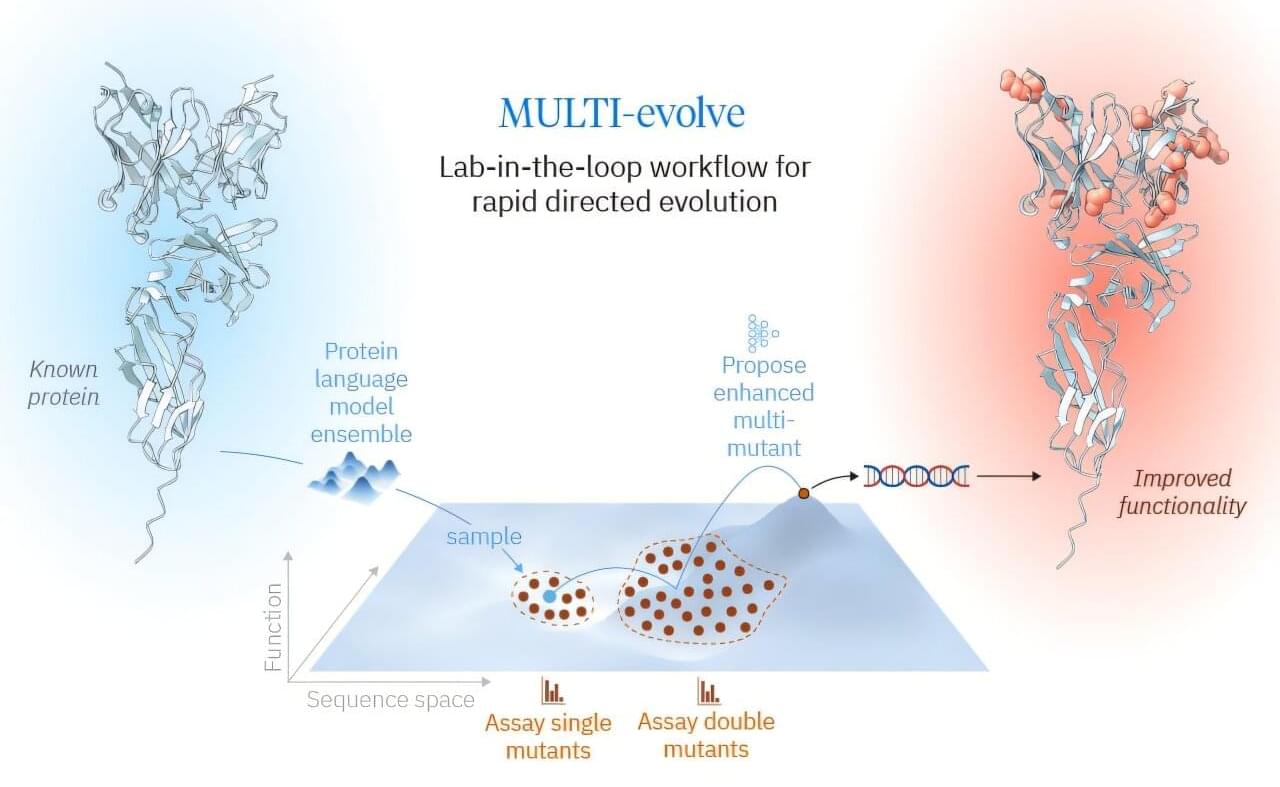
The search space for protein engineering grows exponentially with complexity. A protein of just 100 amino acids has 20100 possible variants—more combinations than atoms in the observable universe. Traditional engineering methods might test hundreds of variants but limit exploration to narrow regions of the sequence space. Recent machine learning approaches enable broader searches through computational screening. However, these approaches still require tens of thousands of measurements, or 5–10 iterative rounds.

With the advent of these foundational protein models, the bottleneck for protein engineering swings back to the lab. For a single protein engineering campaign, researchers can only efficiently build and test hundreds of variants. What is the best way to choose those hundreds to most effectively uncover an evolved protein with substantially increased function? To address this problem, researchers have developed MULTI-evolve, a framework for efficient protein evolution that applies machine learning models trained on datasets of ~200 variants focused specifically on pairs of function-enhancing mutations.

Published in Science, this work represents Arc Institute’s first lab-in-the-loop framework for biological design, where computational prediction and experimental design are tightly integrated from the outset, reflecting a broader investment in AI-guided research.

Elon Musk reveals his most ambitious (and detailed) plan for Mars: 1,000 spacecraft, 20 years of launches, and a self-sustaining city of one million inhabitants on Mars by 2050

At the entrance to Starbase in south Texas, a glowing sign now welcomes visitors with the words “Gateway to Mars.” The display sits in front of SpaceX facilities where giant Starship rockets are being assembled with one bold purpose in mind: Elon Musk wants to build a self-sustaining city on Mars.

In recent years he has begun to put numbers on that dream. Musk has repeatedly said that building the first sustainable city on Mars would require around 1,000 Starship rockets and roughly 20 years of launch campaigns, moving up to 100,000 people per favorable Earth-Mars alignment and eventually reaching about one million settlers plus millions of tons of cargo.

It sounds like science fiction with a project plan. Yet the language he uses, “sustainable city,” is very familiar to climate and energy experts here on Earth. So what does sustainability really mean on a frozen, air-thin world and how does that huge effort interact with the environmental crisis on our own planet?

Midair haptics and levitation may get steadier with predictable ultrasonic airflow

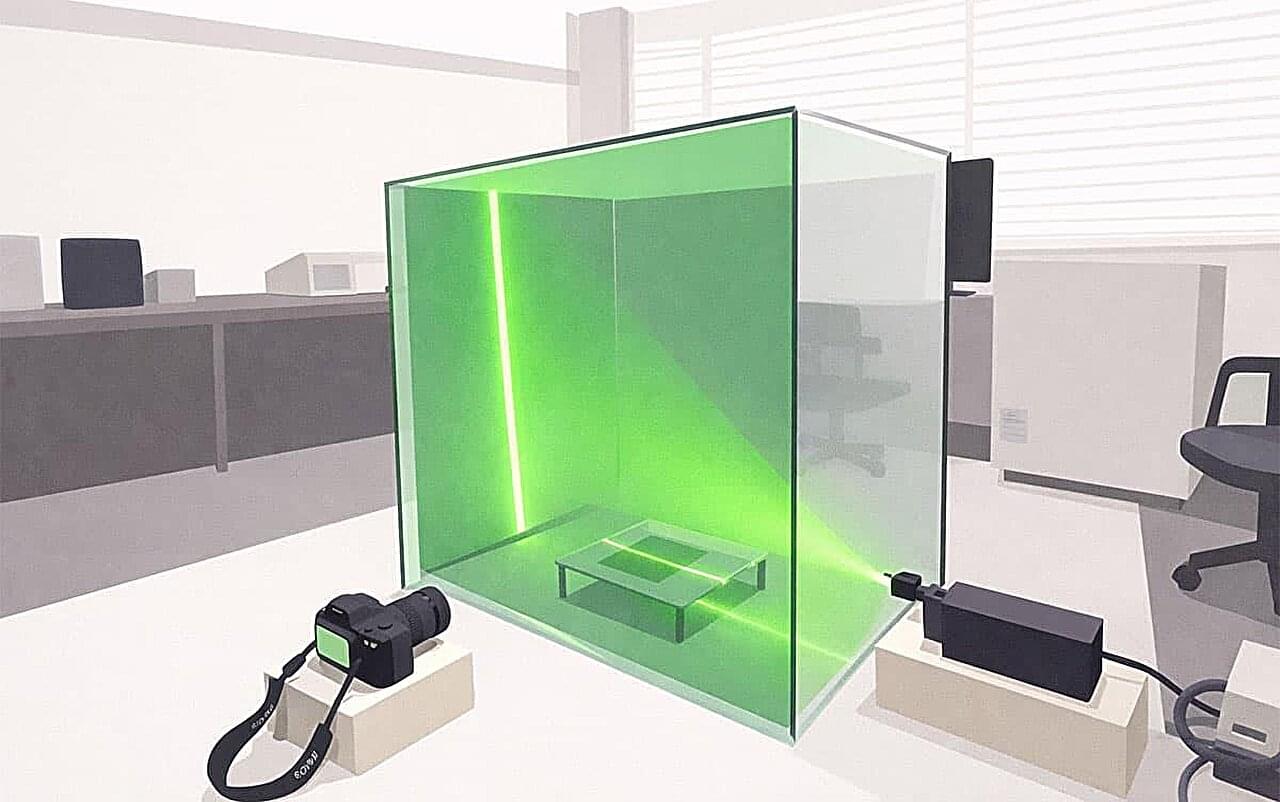
Acoustic streaming generated by airborne ultrasonic phased arrays plays a critical role in the performance of advanced ultrasonic technologies, including midair haptic feedback, odor delivery, and acoustic levitation. Researchers at University of Tsukuba have developed a predictive model for acoustic streaming in phased arrays by integrating three-dimensional acoustic and fluid simulations.

Airborne ultrasonic phased arrays focus ultrasonic waves at prescribed locations in space and dynamically steer them, enabling applications such as noncontact tactile feedback, odor transport, and the levitation of small objects.

Despite the nonnegligible influence of acoustic streaming—steady airflow induced by high-intensity sound fields—on tactile perception and the stability of levitated objects, reliable prediction and modeling of this phenomenon have remained challenging.

How SpaceX and XAI Will Build Moonbase Alpha and Mass Drivers

SpaceX, in collaboration with xAI, plans to build a lunar base called Moonbase Alpha using advanced technologies such as mass drivers, solar power, and Starship, aiming to make human activity on the moon visible, affordable, and sustainable ##

## Questions to inspire discussion.

Launch Infrastructure Economics.

🚀 Q: What launch costs could SpaceX’s moon infrastructure achieve? A: Mature SpaceX moon operations could reduce costs to $10/kg to orbit and $50/kg to moon surface, enabling $5,000 moon trips for people under 100kg (comparable to expensive cruise pricing), as mentioned by Elon Musk.

⚡ Q: How could lunar mass drivers scale satellite deployment? A: Lunar mass drivers using magnetic rails at 5,600 mph could launch 10 billion tons of satellites annually with 2 terawatts of power, based on 2023 San Jose State study updating 1960s-70s mass driver literature.

Starship Capabilities.

/* */