Even supercomputers can stall out on problems where nature refuses to play by everyday rules. Predicting how complex molecules behave or testing the strength of modern encryption can demand calculations that grow too quickly for classical hardware to keep up. Quantum computers are designed to tackle that kind of complexity, but only if engineers can build systems that run with extremely low error rates.
One of the most promising routes to that reliability involves a rare class of materials called topological superconductors. In plain terms, these are superconductors that also have built-in “protected” quantum behavior, which researchers hope could help shield delicate quantum information from noise. The catch is that making materials with these properties is famously difficult.
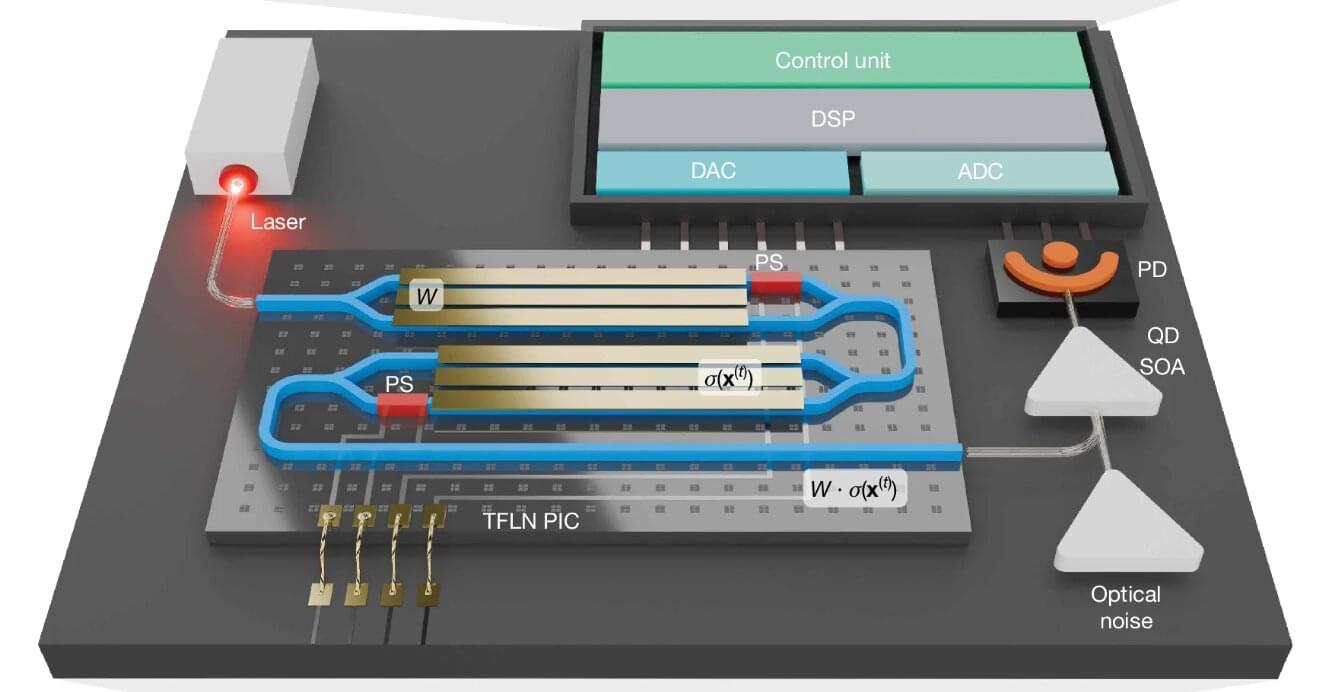
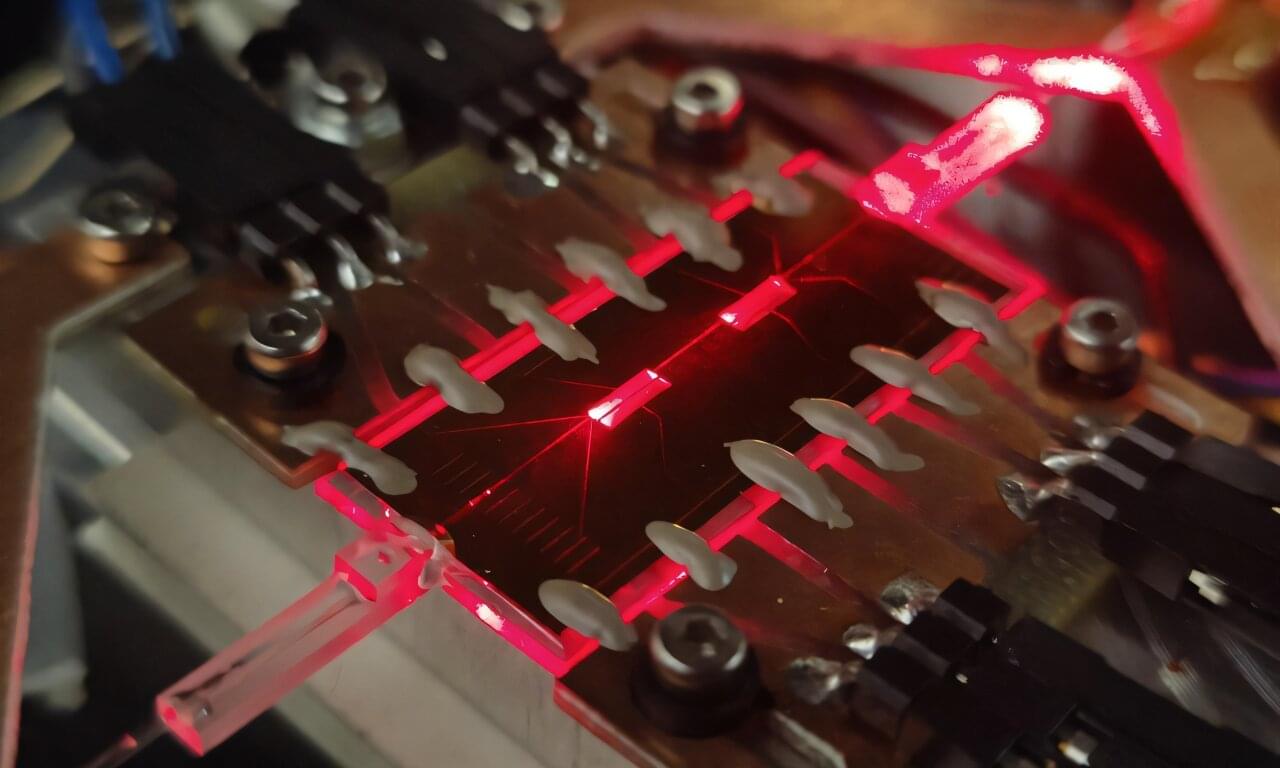
A team of researchers at Queen’s University has developed a powerful new kind of computing machine that uses light to take on complex problems such as protein folding (for drug discovery) and number partitioning (for cryptography). Built from off-the-shelf components, it also operates at room temperature and remains remarkably stable while performing billions of operations per second. The research was published in Nature.
The breakthrough shows that it is possible to build a practical and scalable machine that can tackle extremely difficult problems.
The project, led by Bhavin Shastri, Canada Research Chair in Neuromorphic Photonic Computing and professor in the Department of Physics, Engineering Physics, and Astronomy, with a team of his graduate students including Nayem Al Kayed and Hugh Morison, uses commercially available lasers, fiber optics, and modulators—the same technology that powers today’s internet infrastructure. The team partnered with McGill University researcher David Plant and his graduate student Charles St-Arnault.
Scientists achieved the ‘impossible’ in 2024, teleporting a quantum state through more than 30 kilometers amid a torrent of internet traffic.
In 2024, a quantum state of light was successfully teleported through more than 30 kilometers (around 18 miles) of fiber optic cable amid a torrent of internet traffic – a feat of engineering once considered impossible.
The impressive demonstration by researchers in the US may not help you beam to work to beat the morning traffic, or download your favorite cat videos faster.
Concerns that quantum computers may start easily hacking into previously secure communications has motivated researchers to work on innovative new ways to encrypt information. One such method is quantum key distribution (QKD), a secure, quantum-based method in which eavesdropping attempts disrupt the quantum state, making unauthorized interception immediately detectable.
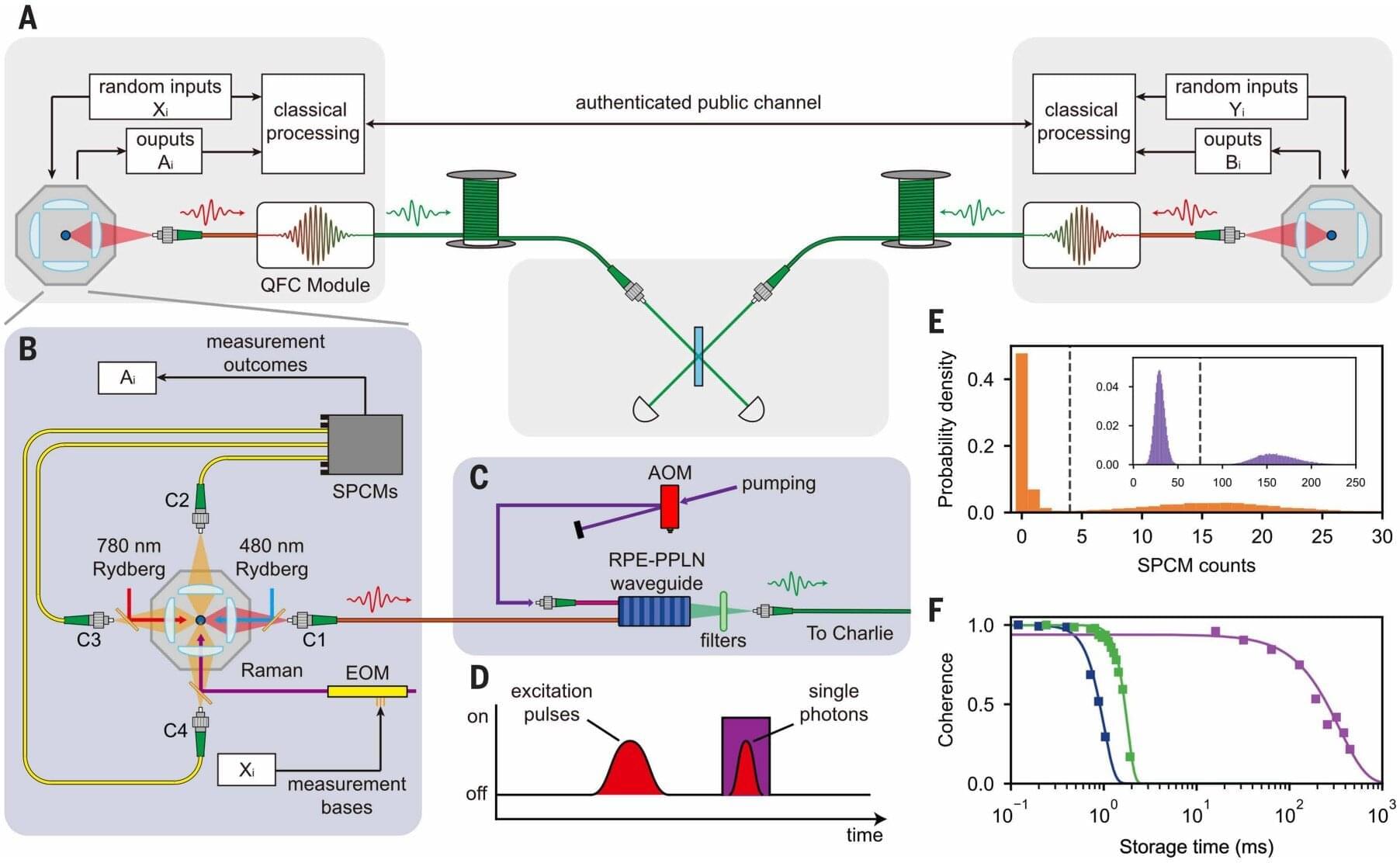
Previous attempts at this solution were limited by short distances and reliance on special devices, but a research team in China recently demonstrated the ability to maintain quantum encryption over longer distances. The research, published in Science, describes device-independent QKD (DI-QKD) between two single-atom nodes over up to 100 km of optical fiber.
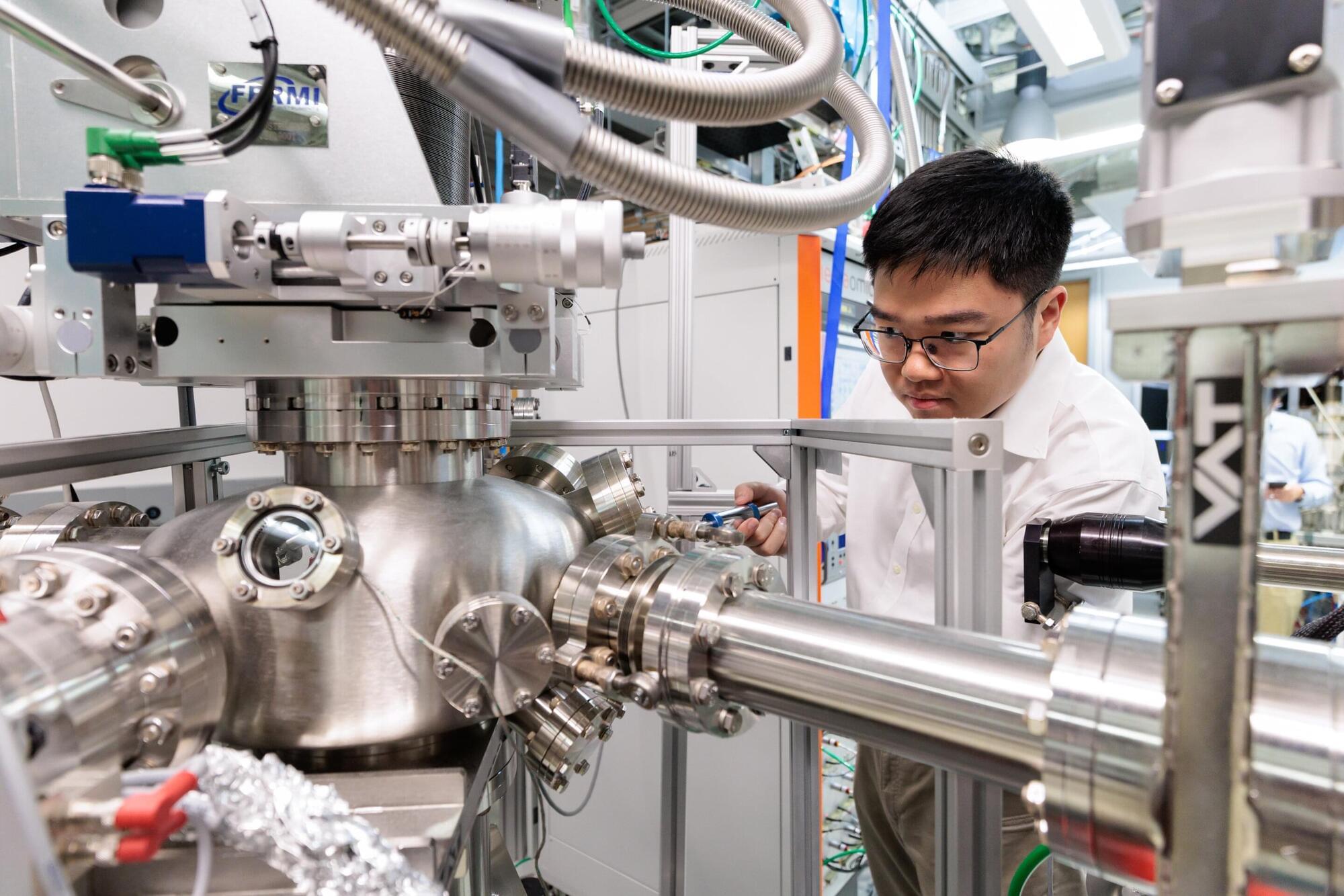
Today’s most powerful computers hit a wall when tackling certain problems, from designing new drugs to cracking encryption codes. Error-free quantum computers promise to overcome those challenges, but building them requires materials with exotic properties of topological superconductors that are incredibly difficult to produce. Now, researchers at the University of Chicago Pritzker School of Molecular Engineering (UChicago PME) and West Virginia University have found a way to tune these materials into existence by simply tweaking a chemical recipe, resulting in a change in many-electron interactions.
The team adjusted the ratio of two elements— tellurium and selenium —that are grown in ultra-thin films. By doing so, they found they could switch the material between different quantum phases, including a highly desirable state called a topological superconductor.
The findings, published in Nature Communications, reveal that as the ratio of tellurium and selenium changes, so too do the correlations between different electrons in the material—how strongly each electron is influenced by those around it. This can serve as a sensitive control knob for engineering exotic quantum phases.
A new threat actor called Amaranth Dragon, linked to APT41 state-sponsored Chinese operations, exploited the CVE-2025–8088 vulnerability in WinRAR in espionage attacks on government and law enforcement agencies.
The hackers combined legitimate tools with the custom Amaranth Loader to deliver encrypted payloads from command-and-control (C2) servers behind Cloudflare infrastructure, for more accurate targeting and increased stealth.
According to researchers at cybersecurity company Check Point, Amaranth Dragon targeted organizations in Singapore, Thailand, Indonesia, Cambodia, Laos, and the Philippines.
Microsoft announced that it will disable the 30-year-old NTLM authentication protocol by default in upcoming Windows releases due to security vulnerabilities that expose organizations to cyberattacks.
NTLM (short for New Technology LAN Manager) is a challenge-response authentication protocol introduced in 1993 with Windows NT 3.1 and is the successor to the LAN Manager (LM) protocol.
Kerberos has superseded NTLM and is now the current default protocol for domain-connected devices running Windows 2000 or later. While it was the default protocol in older Windows versions, NTLM is still used today as a fallback authentication method when Kerberos is unavailable, even though it uses weak cryptography and is vulnerable to attacks.
Microsoft has confirmed that a known issue preventing some Windows 11 devices from shutting down also affects Windows 10 systems with Virtual Secure Mode (VSM) enabled.
VSM is a Windows security feature that creates an isolated, protected memory region separate from the normal operating system (known as the “secure kernel”), using hardware virtualization that is extremely difficult for malware to access, even after a system compromise.
It protects sensitive credentials, encryption keys, and security tokens from kernel-level malware and pass-the-hash attacks, and it enables security features such as Credential Guard, Device Guard, and Hypervisor-Protected Code Integrity in Windows 10/11 Enterprise editions.
IDQ’s QRNG chip is available in six models, depending on size, performance, power consumption and certifications, in order to fit various industry-specific needs. All IDQ QRNG chips have received NIST Entropy Source Validation (ESV) certification on the independently and identically distributed (IID) entropy estimation track SP 800-90B.
ID Quantique is the first company to achieve an ESV certificate with a quantum entropy source and IID estimation track. Such randomness provides the most trusted random keys for encryption. Since October 2022 it has been mandatory for cryptographic modules aiming for FIPS 140–3 certification to have an ESV validated entropy source. This ESV IID Certificate #63 will also facilitate IDQ’s customers who integrate IDQ’s Chips into their own devices to go through the NIST’s Cryptographic Module Validation Program (CMVP).
New cadets. New era. Infinite possibilities. Catch a new episode of Star Trek: Starfleet Academy every Thursday starting Jan. 15th on Paramount+.
Can quantum tunneling occur at macroscopic scales? Neil deGrasse Tyson and comedian Chuck Nice sit down with John Martinis, UCSB physicist and 2025 Nobel Prize winner in Physics, to explore superconductivity, quantum tunneling, and what this means for the future of quantum computing.
What exactly is macroscopic quantum tunneling, and why did it take decades for its importance to be recognized? We’ve had electrical circuits forever, so what did Martinis discover that no one else saw? If quantum mechanics usually governs tiny particles, why does a superconducting circuit obey the same rules? And what does superconductivity really mean at a quantum level?
How can a system cross an energy barrier it doesn’t have the energy to overcome? What is actually tunneling in a superconducting wire, and what does it mean to tunnel out of superconductivity? We break down Josephson Junctions, Cooper pairs, and other superconducting lingo. Does tunneling happen instantly, or does it take time? And what does that say about wavefunction collapse and our assumptions about instantaneous quantum effects?
Learn what a qubit is and why macroscopic quantum effects are important for quantum computing. Why don’t quantum computers instantly break all encryption? How close are we to that reality, and what replaces today’s cryptography when it happens? Is quantum supremacy a scientific milestone, a geopolitical signal, or both? Plus, we take cosmic queries from our audience: should quantum computing be regulated like nuclear energy? Will qubits ever be stable enough for everyday use? Will quantum computers live in your pocket or on the dark side of the Moon? Can quantum computing supercharge AI, accelerate discovery, or even simulate reality itself? And finally: if we live in a simulation, would it have to be quantum all the way down?
Thanks to our Patrons Fran Rew, Shawn Martin, Kyland Holmes, Samantha McCarroll-Hyne, camille wilson, Bryan, Sammi, Denis Alberti, Csharp111, stephanie woods, Mark Claassen, Joan Tarshis, Abby Powell, Zachary Koelling, JWC, Reese, Fran Ochoa, Bert Berrevoets, Barely A Float Farm, Vasant Shankarling, Michael Rodriguez, DiDTim, Ian Cochrane, Brendan, William Heissenberg Ⅲ, Carl Poole, Ryan McGee, Sean Fullard, Our Story Series, dennis van halderen, Ann Svenson, mi ti, Lawrence Cottone, 123, Patrick Avelino, Daniel Arvay, Bert ten Kate, Kristian Rahbek, Robert Wade, Raul Contreras, Thomas Pring, John, S S, SKiTz0721, Joey, Merhawi Gherezghier, Curtis Lee Zeitelhack, Linda Morris, Samantha Conte, Troy Nethery, Russ Hill, Kathy Woida, Milimber, Nathan Craver, Taylor Anderson, Deland Steedman, Emily Lennox, Daniel Lopez,., DanPeth, Gary, Tony Springer, Kathryn Rhind, jMartin, Isabella Troy Brazoban, Kevin Hobstetter, Linda Pepper, 1701cara, Isaac H, Jonathan Morton, JP, טל אחיטוב Tal Achituv, J. Andrew Medina, Erin Wasser, Evelina Airapetova, Salim Taleb, Logan Sinnett, Catherine Omeara, Andrew Shaw, Lee Senseman, Peter Mattingly, Nick Nordberg, Sam Giffin, LOWERCASEGUY, JoricGaming, Jeffrey Botkin, Ronald Hutchison, and suzie2shoez for supporting us this week.