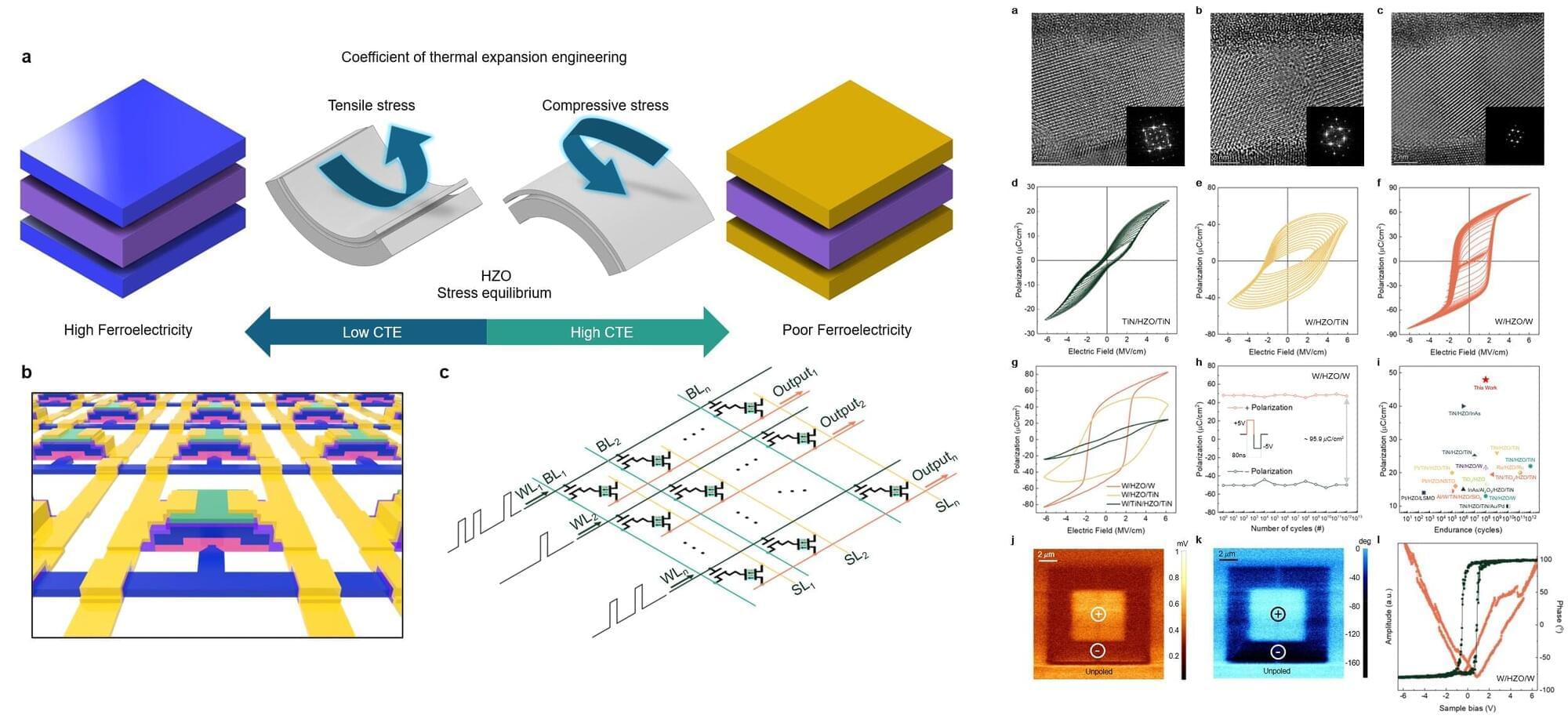
A research team led by Professor Taesung Kim from the School of Mechanical Engineering at Sungkyunkwan University has developed a technology that precisely controls the internal structure of semiconductors using heat, much like stamping out “bungeoppang” (fish-shaped pastry) in a mold. The team report that this approach improves the performance of next-generation artificial intelligence (AI) hardware. With this technology, complex AI computations can be processed more quickly using significantly less electricity than before. The findings are published in the journal ACS Nano.
Most computers and smartphones we use today operate based on the “von Neumann architecture.” This structure is similar to having a desk (the processor) and a bookshelf (the memory) placed far apart.
Each time you study, you have to go back and forth to get a book, which takes time and effort. To solve this problem, a method called “in-memory computing” has been proposed, in which computation is carried out directly inside the memory. The key component that enables this approach is the “ferroelectric transistor,” which is the focus of this study.