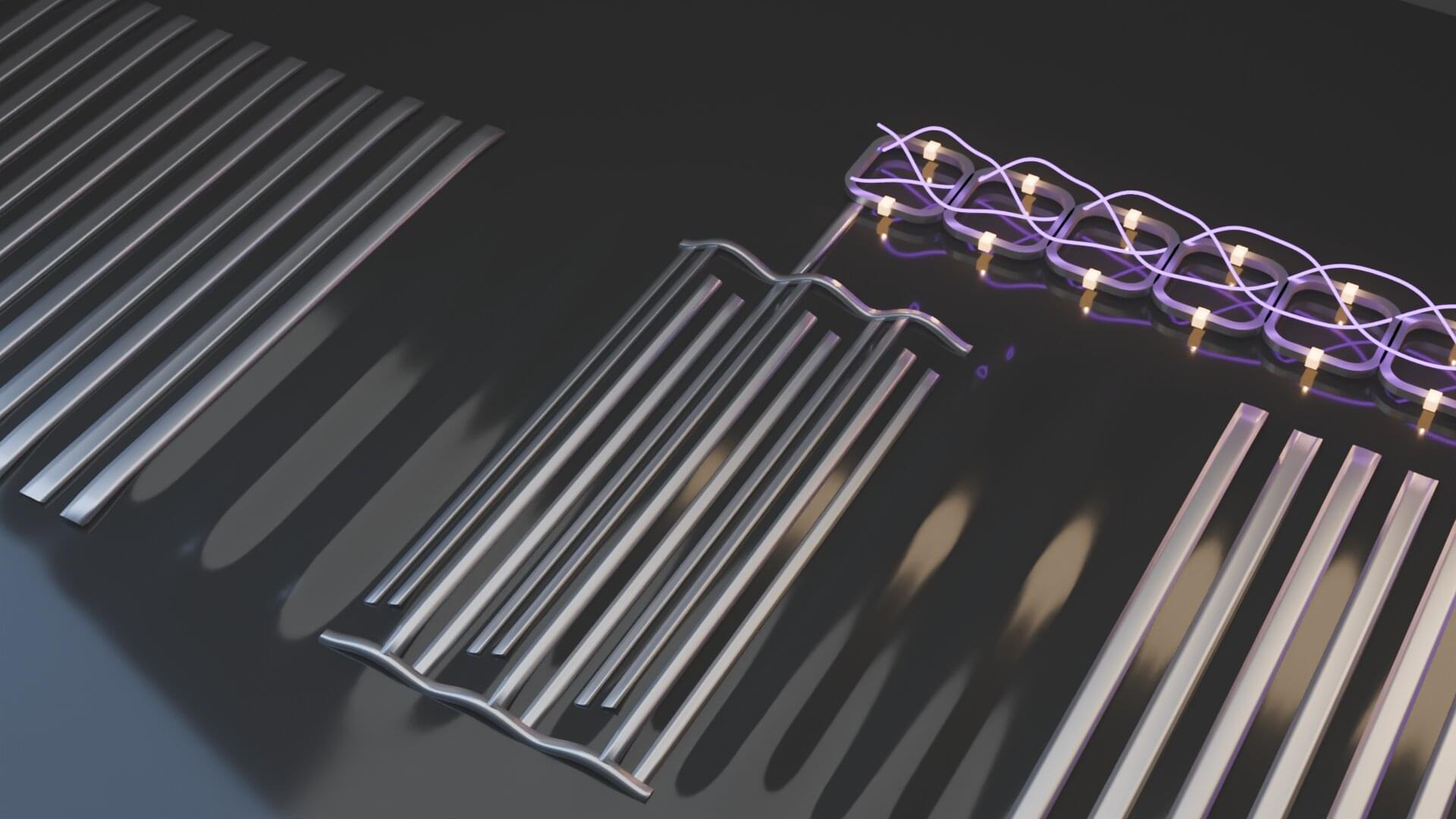
Caltech scientists have developed a new way to produce optical frequency combs—important tools in devices that keep time and measure distances very precisely—at the chip scale, an advance that should make it easier to incorporate such combs in optical devices and more practical to use them outside the laboratory.
To generate the combs, the new research demonstrates the utility of a robust class of light pulses, called topological solitons, that had been previously predicted but largely unexplored until now. The scientists, led by Caltech’s Alireza Marandi, professor of electrical engineering and applied physics, describe their findings in a paper published in Nature.
Frequency combs are light sources that emit a precise ruler-like “comb” of many evenly spaced frequencies. Over the last three decades, they have become important tools in spectroscopy, in telecommunications, and even in astronomical research. Currently, most frequency comb sources rely on bulky tabletop laser sources. The new work shows that an electrically pumped laser diode integrated with a photonic chip with strong nonlinearity can serve as a frequency comb source.